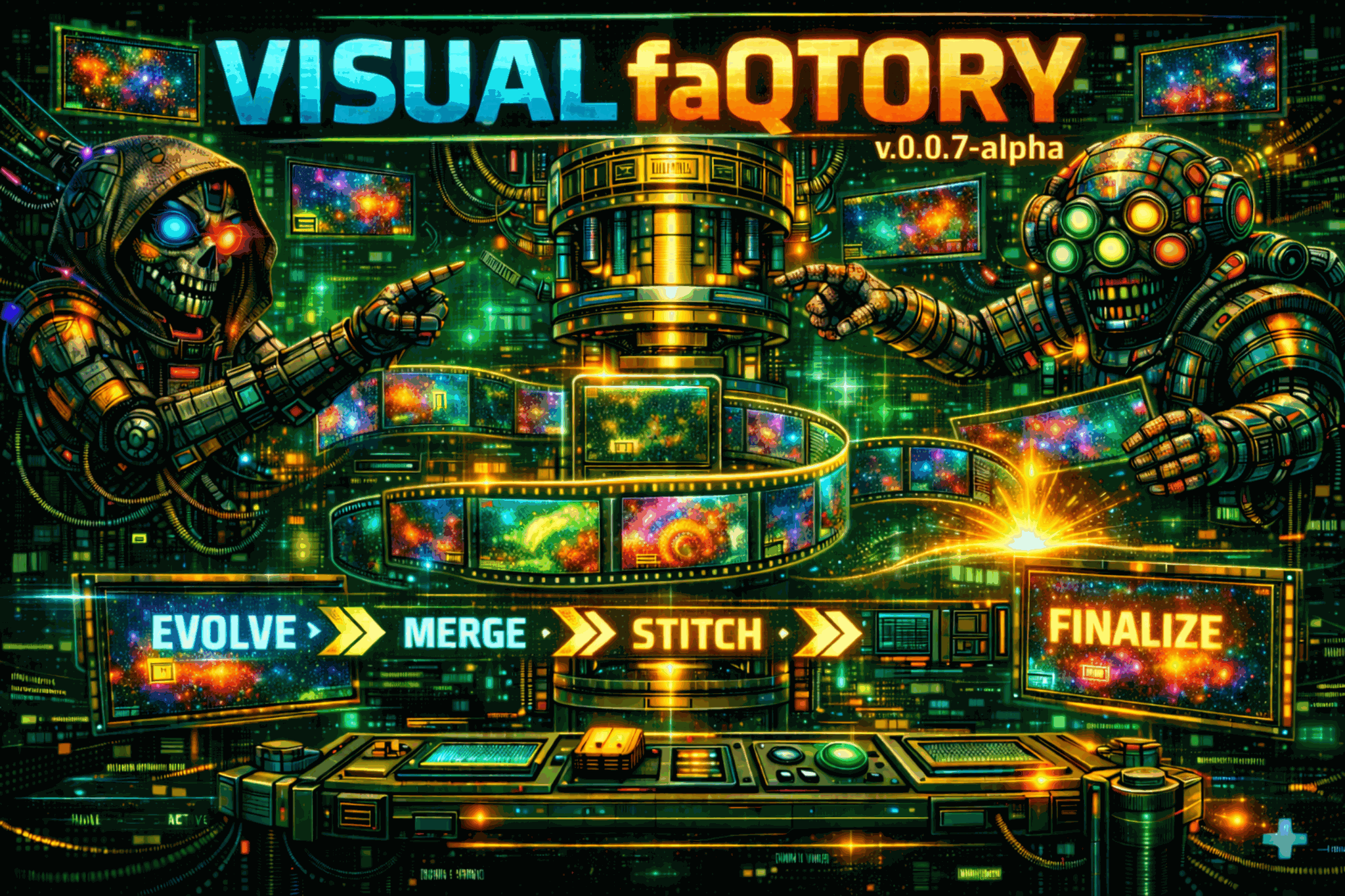
Visual FaQtory is best described right now as a ComfyUI-first local visuals yard.
That is the honest centre of gravity.
Yes, there are other backend lanes in the repo now. Yes, LTX-Video and Veo are real parts of the project. But the most tested, most stable, most controllable, and most rewarding free-unlimited path is still the local one: ComfyUI + JuggernautXL SDXL for image generation + SVD XT for motion.
That combo is where the strongest results are landing at the moment.
The Core Workflow That Actually Slaps
The current project does not treat video generation like one magic black-box prompt box.
It works much better as a staged yard:
Generate a strong key image first.
Turn that image into motion second.
Carry continuity forward into the next cycle.
That sounds obvious, but it is the difference between random novelty clips and visuals that can actually hold together over time.
The attached Visual FaQtory repo backs this up with a real story engine, run-state handling, reinject chaining, finalizer logic, and backend abstractions instead of just hand-wavy prompt talk.
Why ComfyUI Comes First
ComfyUI is still the current backbone because it gives proper control where it matters.
You can inspect the workflow, swap pieces, debug where quality falls apart, and keep the whole thing running locally without being held hostage by token meters or provider limits.
That matters a lot once the project stops being a toy and starts being something you want to run for a whole set, stream, or experimental visual session.
The sweet spot at the moment is:
JuggernautXL SDXL for the base imagery
SVD XT for the image-to-video stage
That pairing is still the best-tested free-unlimited setup in the yard.
Story-Driven Live Visuals Changed the Whole Feel
One of the hardest-hitting shifts in Visual FaQtory is that it is no longer just about rendering isolated clips.
The repo now leans into live visuals generated from a running text story.
Instead of blasting unrelated prompts at a model and hoping for vibes, the system can move through a narrative in overlapping windows, evolve the look from cycle to cycle, and keep some actual continuity alive.
That makes way more sense for DJ sets, stream visuals, and longer audiovisual pieces.
QR Crowd Control Is Not Gimmick Theatre
The crowd-control layer is one of the dopest parts of the current project.
Visual FaQtory now includes a proper QR submission flow, queue handling, prompt filtering, overlay endpoints, and fail-open behaviour so the live system can keep moving even if the crowd side goes weird.
So instead of audience input being a risky bolt-on, it becomes a controlled steering layer.
That is a proper performance tool move.
Live Output Matters Too
The project is not just about generating files and dumping them in a folder.
The inspected repo also includes the live-show side: OBS helpers, SRT watcher scripts, split-box deployment docs, queue overlays, and operator flows for running the GPU generator separately from the actual stream / playout machine.
That is the difference between “AI art experiment” and a visuals system you can actually drive in anger.
Where LTX-Video and Veo Fit
LTX-Video and Veo both matter, but they are not the first headline.
LTX-Video is a serious extra lane, especially when you want to stay self-hosted and lean into local GPU workflows differently.
Veo gives a cloud-side path where local GPU constraints are the limiting factor.
But the project should be described honestly:
ComfyUI-first at the top. LTX-Video and Veo later in the story as expansion lanes.
That is the actual current state.
Why This Project Exists
Visual FaQtory carries the same construction-yard mindset as QonQrete, just pointed at visuals instead of code.
The point is not to chase whatever video model is loudest this week.
The point is to build a visuals pipeline that is inspectable, chainable, practical for real shows, and wonky enough to stay fun.